
How AI Improves Multifamily Underwriting Accuracy

The Constraints of Traditional Underwriting
For decades, the foundation of real estate investment has been the meticulous, manual review of financial documents. In the high-stakes multifamily sector, however, this traditional approach is showing its age. We can all picture the scene: an underwriter surrounded by stacks of paper or endless spreadsheets, manually keying in line items from rent rolls and T12 statements. This isn’t just tedious work; it’s a primary source of small errors that can quietly compound, leading to flawed financial models and misguided investment decisions.
This reliance on manual processes creates a significant bottleneck. While your team is painstakingly verifying data, faster competitors may have already submitted their offers. In a market where timing is everything, this sluggish pace means promising opportunities can slip away. The entire multifamily underwriting process becomes a race against the clock that manual methods are destined to lose.
Furthermore, conventional analysis leans heavily on static historical data. While past performance is a critical piece of the puzzle, it offers a rearview mirror perspective. It fails to account for the dynamic nature of modern markets, from sudden demographic shifts to fluctuating economic indicators. This leaves investment theses vulnerable to unforeseen changes.
Perhaps the most significant limitation is the lack of scalability. The manual effort required to vet a single deal makes it nearly impossible for teams to analyze a high volume of opportunities. This constraint directly limits portfolio growth, forcing firms to pass on potentially lucrative assets simply because they lack the bandwidth to evaluate them properly.
Core AI Applications for Underwriters

Moving away from the constraints of manual work, AI introduces a set of powerful capabilities that directly address these long-standing inefficiencies. Instead of replacing the underwriter, these tools act as a force multiplier, handling repetitive tasks with speed and precision. This allows analysts to focus on strategy and decision making.
Automated Data Extraction and Validation
The initial step of any underwriting project, data entry, is also the most prone to human error. AI-powered tools fundamentally change this. Modern automated underwriting software can read and interpret unstructured documents like PDFs of T12s and complex rent rolls, extracting and structuring the necessary data in seconds. This not only eliminates hours of manual labour but also ensures the foundational data for your model is accurate from the start. For a closer look at this technology, you can explore how our tools achieve the automation of rent roll and T12 extraction.
Dynamic Real-Time Market Analysis
Traditional comparable property reports often become outdated the moment they are printed. AI, however, can analyse live market data streams. It synthesises information on current rental rates, new construction in the pipeline, local employment trends, and even demographic shifts. This provides a living, breathing view of the market, giving underwriters insights that are current and forward looking, not just historical.
Predictive Financial Modeling
Human analysis is excellent at spotting clear trends, but machine learning algorithms excel at identifying subtle, non-obvious patterns within vast datasets. By analysing thousands of data points from past deals and market behaviour, AI can build predictive models that forecast metrics like Net Operating Income (NOI) and occupancy rates with greater accuracy. It moves beyond simple linear projections to model complex, real-world dynamics.
Advanced Risk Assessment
Effective real estate risk assessment AI goes beyond just flagging obvious issues like a high vacancy rate. It identifies interconnected risks that might otherwise be missed. For example, it could correlate a specific tenant industry concentration with local economic forecasts to predict potential default risk, or model the impact of rising utility costs on future expenses. This provides a much deeper and more nuanced understanding of a property’s potential vulnerabilities.
Enhancing Key Financial Metrics with AI
With those AI capabilities in place, the focus shifts to their direct impact on the financial metrics that drive investment decisions. Knowing how to use AI in underwriting is about translating technological power into more reliable financial forecasts. It’s the difference between a rough estimate and a finely tuned projection.
AI refines Net Operating Income (NOI) projections by moving beyond static historical averages. It can model variable income streams and expenses with greater precision, analysing tenant-level data to identify rent growth potential or flagging expense lines that deviate from market norms. This creates a more dynamic and realistic NOI forecast.
From there, the Debt Service Coverage Ratio (DSCR) becomes a more robust measure of resilience. Instead of calculating it against a single, fixed debt service, AI enables sophisticated stress testing. It can run thousands of simulations against potential economic shocks, like sudden interest rate hikes or unexpected vacancy increases, revealing how well the property’s cash flow can withstand adversity.
Finally, this enhanced accuracy flows directly into the Internal Rate of Return (IRR). More reliable inputs for rent growth, expense inflation, and exit cap rates produce a more trustworthy long-term return forecast. As highlighted in an analysis by Blooma.ai, these core metrics are the foundation of multifamily analysis, and their accuracy is paramount. AI also standardises these calculations across a portfolio, ensuring every asset is evaluated with the same rigorous, data-driven methodology. This level of consistency is a core function of our underwriting platform, which is designed to bring institutional-grade analysis to every deal.
| Metric | Traditional Approach | AI-Enhanced Approach | Key Improvement |
|---|---|---|---|
| Net Operating Income (NOI) | Based on historical T12 and static growth assumptions. | Models dynamic variables; analyses tenant-level data for rent growth potential. | More accurate and forward-looking income projection. |
| Debt Service Coverage Ratio (DSCR) | Calculated against a fixed debt service; limited scenario analysis. | Runs thousands of stress tests against interest rate and vacancy fluctuations. | Robust understanding of cash flow resilience. |
| Internal Rate of Return (IRR) | Relies on broad market assumptions for exit cap rate and rent inflation. | Uses predictive analytics to forecast market-specific exit cap rates and expense growth. | Higher confidence in long-term return projections. |
Note: This table illustrates the shift from static, historical-based calculations to dynamic, predictive modeling. The AI-enhanced approach provides a more nuanced and reliable financial forecast by incorporating a wider range of variables and potential scenarios.
A Strategic Framework for AI Adoption
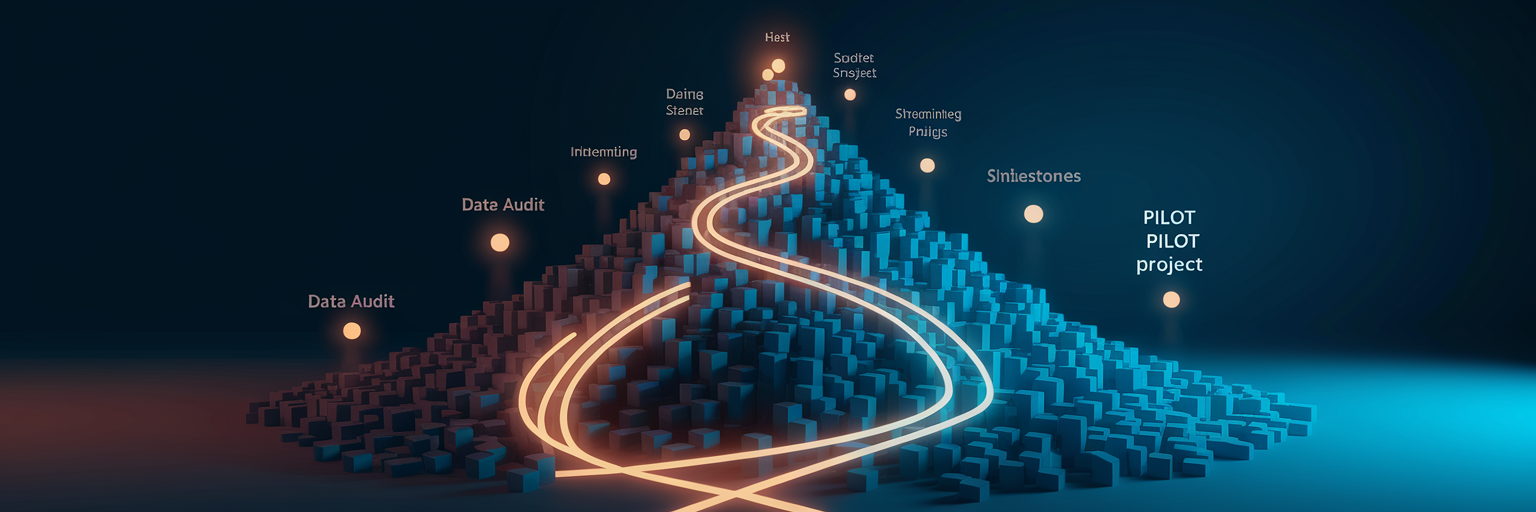
Integrating AI into your underwriting workflow is more than a technical upgrade; it requires a thoughtful strategic approach. Simply buying a tool without a plan is a recipe for failure. A successful adoption hinges on aligning the technology with your business goals and preparing your team for a new way of working. Here is a clear framework to guide the process:
- Define Clear Business Objectives
Before evaluating any software, ask what you want to achieve. Is the primary goal to increase deal flow by 50%? Is it to reduce underwriting time from days to hours? Or is it to improve risk detection on value-add properties? Technology must serve a specific business purpose, and defining it upfront ensures you choose the right solution. - Conduct a Thorough Data Audit
AI models are powered by data, and the “garbage in, garbage out” principle applies absolutely. Your historical deal information, rent rolls, and operating statements are invaluable assets. Before implementation, conduct an audit to ensure this data is clean, organised, and accessible. This groundwork is essential for training and validating any AI system effectively. - Manage the Human Element
We’ve all seen new software gather dust because the team resisted it. The key is to frame AI as a tool that empowers underwriters, not one that replaces them. By automating the most tedious parts of their job, AI frees them to focus on higher-value strategic analysis, negotiation, and relationship building. Proper training and clear communication are critical for securing team buy-in. - Implement a Phased Rollout
Avoid the temptation of a company-wide launch on day one. Start with a pilot project on a small, defined set of properties. This allows your team to learn the new process, demonstrate early wins, and build momentum. Selecting the right AI tools for real estate is a critical part of this strategy, and a pilot provides the perfect opportunity to test them. As noted in a guide from Harvard Business School Online, a well-defined strategy is crucial for success. Teams can begin experimenting by signing up for our application to see the benefits firsthand.
Beyond Underwriting: AI’s Portfolio-Wide Impact
The value of artificial intelligence does not end once a deal is closed. In fact, the rich, structured data gathered during an AI-powered underwriting process becomes a foundational asset for intelligent portfolio and asset management throughout the entire ownership lifecycle. This transforms the initial analysis from a static snapshot into a living model that guides performance over time.
One of the most immediate post-acquisition benefits is in boosting operational efficiency. The same AI that projected operating expenses can be used to control them. For example, predictive maintenance algorithms can analyse data from HVAC systems or plumbing to forecast potential failures before they happen, allowing for proactive repairs that are far less costly than emergency fixes.
On the income side, AI helps enhance the tenant experience, which is directly linked to retention and stable revenue. As explored in an article by Ascendixtech, AI-powered leasing chatbots can provide instant answers to prospective and current residents 24/7, improving satisfaction and freeing up property management staff for more complex issues. This contributes to a stronger community and lower turnover, reinforcing the income assumptions made during underwriting.
Ultimately, AI turns the multifamily underwriting process into the beginning of a continuous, data-driven management cycle. The initial model becomes a dynamic tool that helps owners and asset managers make proactive decisions, from optimising rental rates to planning capital expenditures. It provides the intelligence needed to maximise performance and mitigate risk long after the acquisition is complete.